
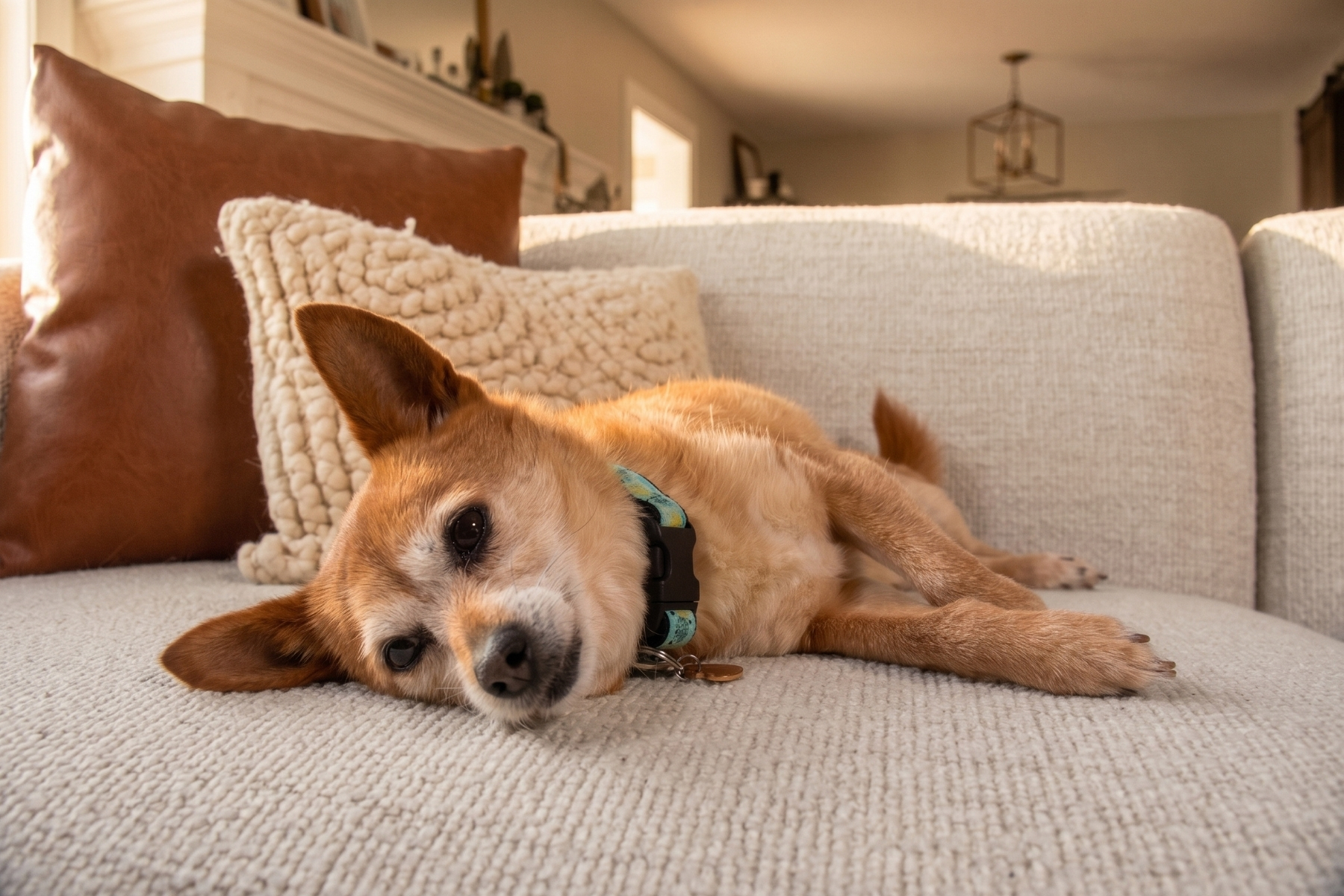
If your Pomeranian is past nine and you’ve started wincing every time they launch off the couch, we get it. Small dogs land hard for their size, Poms carry a breed-wide weakness in the kneecap, and by the senior years a bad landing could get complicated.
Bella is our senior dog. She’s 11, she’s a Pomeranian mix, and she has had a mild luxating patella since a vet spotted it when she was young. It shows up as stiffness in that joint, and every single time she gets up, she stretches that back leg all the way out behind her before she takes a step, a little ritual that has been part of her for a decade.
Her case is mild, so what we do for her is not a medical protocol. It’s a home arranged so that the dozens of small things she does every day cost her joints as little as possible. Stairs, a bed, a gate, a few rules, and one decision about walks that took us years to make.
Why a Luxating Patella Makes Jumping the Real Risk
A luxating patella is a kneecap that slips out of its dedicated groove. It’s one of the most common orthopedic conditions in toy breeds, Pomeranians included, and it ranges from mild to a knee that pops out with every stride. Mild cases like Bella’s often show up as nothing more than stiffness in the joint and need only management; severe ones can need surgery.
Impact can aggravate a luxating patella. Every hard landing drives the kneecap against the edge of that groove, and a senior dog has less muscle around the joint to absorb the force. Over a lifetime, the damage isn’t one dramatic jump; it’s thousands of ordinary ones, on and off furniture, that nobody thought twice about.
That’s why the plan for Bella is built around removing landings rather than adding treatments. Disclaimer: we are not vets. If your Pom limps, skips a step mid-stride, or holds a leg up after a jump, please go to your vet for an examination and follow their advice.
Pet Stairs for a Senior Pomeranian: The Change That Removes the Most Impact
The couch is where our three dogs spend their day, so the couch is where the landings pile up. A set of cushioned COZY KISS pet stairs sits flush against it, and when they’re there, Bella uses them. Coming down is the hard landing, so even if your dog can’t wait to jump up on the couch, do your best to get them to use the stairs back down.
To be clear, Bella can still jump. She’s over 10 pounds, sturdier than a show-ring Pom, and she hops on and off a chair without help. But the stairs are visibly easier on that stiff knee, and every jump she skips is one less hard landing on it. They’re our peace of mind as she gets older.
Placement matters more than anything. Put the stairs at the exact spot your dog already jumps, flush against the furniture with no gap, or they’ll take the old route out of habit. We tried a hard plastic set first and the dogs refused it over the hollow sound. The quiet foam and low, curved steps are why this pair stayed. The full story is in our pet stairs guide.
Start stairs before you think you need them. Boqui, our puppy, fractured a leg jumping off a lap. Not off anything tall. It’s far easier to build the habit in a young dog than to introduce it to a sore, suspicious senior after something has gone wrong.
Dog Ramp vs. Stairs for a Senior Pom (and Why We Don’t Own a Ramp)
People ask us whether a ramp is kinder to an older knee than stairs. It depends on the dog. A ramp removes the stepping motion completely: the dog walks up a gentle incline with no vertical movement in the joint. For a Pom with advanced arthritis, a bad back, or a knee that luxates on every stride, that’s a real advantage.
The trade-off is floor space. To reach couch height at an incline a small dog will trust, a ramp has to run long. A short, steep ramp is worse than stairs, because the dog scrambles or slides on it. Stairs take a fraction of the space and suit a dog who can still step comfortably.
We don’t own a ramp. One long enough for our couch would take up a permanent chunk of the living room floor and sit right where three dogs and their people walk all day. Bella still steps comfortably, so low cushioned stairs do the same job in a fraction of the space.
If her knee gets worse, a ramp is the next thing we’d add. We’ll write about it once we’ve lived with one.
Where a Senior Pom Sleeps
Bella sleeps on her own bed, on the floor. It’s the safest place in the house for her knee. Nothing to jump on, nothing to jump off, and memory foam under her joints instead of cheap fill.
The bed is the Bedsure ComfyFleece orthopedic bed, the one all three dogs fight over. The memory foam spreads a small dog’s weight across the whole surface, and the low front lets a stiff dog step in without lifting a leg over a bolster. A senior spends most of her day lying down. The surface she does it on matters.
We cover why we chose this bed, and the waterproof layer that saved it during Boqui’s puppy accidents, in our orthopedic bed review.
Our bed is off limits, and has been since before Bella was a senior, so she has never once jumped off a mattress. She waits at the edge and we lift her on and off. She’s so used to it she doesn’t even try. Decide this early. It’s a much easier rule to set with a young dog than to introduce at 10.
The Gate: Keeping a Senior in the Rooms Set Up for Her
Stairs at the couch don’t help if your dog wanders off and jumps on and off a dining chair in another room. A senior who follows you everywhere will find furniture you never thought about.
Our freestanding wood gate went up years ago for a different reason: Beignet bolted out the front door twice. It stayed because it keeps the dogs in the part of the house we’ve set up for them, with the stairs, the beds, and the rugs.
It comes down for parties and goes back up after, and in a room of warm neutrals it looks like furniture. We cover which gate and where to put it in our dog gate guide.
Walks, Exercise, and the Senior Who Says No
For years we tried to get Bella to walk. She’d go two blocks, sit down on the sidewalk, and wait to be carried home. We treated it as stubbornness. Eventually we asked the vet, who told us plainly that some dogs just don’t like walks, and that a dog with a knee like hers may be uncomfortable on pavement without any way to tell us.
So Bella doesn’t walk anymore, and nobody makes her. She potties, pads around the house, plays with the puppy when she feels like it, and goes back to her bed for a nap. We do watch her weight. Every extra ounce on a small dog is extra load on that knee, and that’s the one rule we don’t bend on.
That doesn’t mean a senior dog should stop moving. Gentle, regular movement keeps the muscle around a bad knee doing its job, and a dog who stops moving loses that support faster. It means listening when your dog tells you something hurts, and finding the movement they’ll do willingly.
Joint Supplements for a Senior Pom: We Haven’t Picked One Yet
Bella’s case is mild, so we haven’t put her on a joint supplement yet. We’re looking into it now that she’s 11, and we’d rather tell you that than make up a recommendation. Everything else on this page has been tested in our house for years. A supplement we bought last week hasn’t.
Our vet’s advice: a supplement is an add-on, and the right one depends on the dog’s weight, how bad the knee is, and whatever else she’s taking. Ask your vet before you buy one. If you’ve found one your vet approved and your senior Pom actually eats, we’re asking about it in our first newsletter, and we’ll report back on what we try.
What This Comes Down To
None of this is dramatic. Bella’s knee hasn’t needed surgery or medication. It’s needed a house where she rarely lands hard, sleeps on foam instead of floor, stays in the rooms set up for her, and skips the walks she doesn’t want.
If you do one thing this week, put stairs at the piece of furniture your senior Pom uses most, and reward them every time they take the stairs down. Then book a vet visit and build the rest of the setup around what they tell you.