Search “Pomeranian haircut styles,” and you get galleries. Teddy bear cuts, lion cuts, fox cuts, paw-print-cute names all the way down, and not one caption telling you how they might change your dog’s coat or which of those dogs grew their coat back.
A Pomeranian haircut isn’t a hairstyle decision the way it is for a Poodle or a Shih Tzu. It’s a decision about a double coat that this breed is famously bad at regrowing. Some of the styles in those galleries are harmless trims. Some of them are shave-downs wearing a cuter name.
We have three Poms, and none of them has ever had a clipper cut because we’ve read enough regrowth horror stories to know the odds. So here’s the information we wish those galleries came with: which styles are safe, which ones risk the coat, and exactly what to say to a groomer so the double coat stays healthy and beautiful.
Do Pomeranians need haircuts?
Not in the way most people mean the question. A Pomeranian’s coat maintains its own length. It doesn’t grow indefinitely like a Poodle’s or a Yorkie’s, so there is nothing that has to be cut for the dog’s comfort. Left alone, brushed and bathed, the coat holds its shape for the dog’s whole life.
What a Pomeranian benefits from is tidying: the outline of the pants and ruff shaped with scissors, the paws neatened, the sanitary area kept short. A clean-up. Everything beyond that is a style choice, and it should be weighed against what it can cost the dog.
The cost question comes down to the double coat. Two layers: a soft, dense undercoat that insulates in both directions, and the longer guard hairs that give the coat its shape, repel water, and block sun. The layers regrow on different schedules, and in this breed the guard hairs sometimes come back patchy, cottony, or not at all. That failure has a name, post-clipping alopecia, and Pomeranians are one of the highest-risk breeds for it. The full explanation lives in our shaving article.
The main question: How close to the coat are you cutting?
Forget the style names for a second. Groomers can use the same names to mean different things. The question that actually sorts a safe cut from a risky one is this:
How close does the blade get to the undercoat? Scissors shaping the tips of the guard hairs: safe. Clippers cutting down into or through the undercoat: that’s a shave, whatever the style is called.
A trim that takes the scraggly tips off the guard hairs leaves the coat system intact. The undercoat is untouched, the guard hairs still do their job, and the growth cycle never gets interrupted. A clipper cut that goes short enough to reach the undercoat interrupts the cycle, and now you’re rolling the same dice as a full shave-down: months of cottony regrowth that mats worse than the original coat, and a real chance the guard hairs never fully return.
Pomeranian haircut styles that are safe for the coat
The natural trim (what show Pomeranians get)
The coat is left at full length and shaped with scissors: the outline rounded off, the pants and ruff tidied, stray wisps evened out, paws and hocks neatened. Done well, it doesn’t look like a haircut at all. It looks like a Pomeranian on a very good day. This is what show dogs get, it’s what breed-standard groomers default to, and it’s the style with zero coat risk because nothing but guard-hair tips ever gets cut.
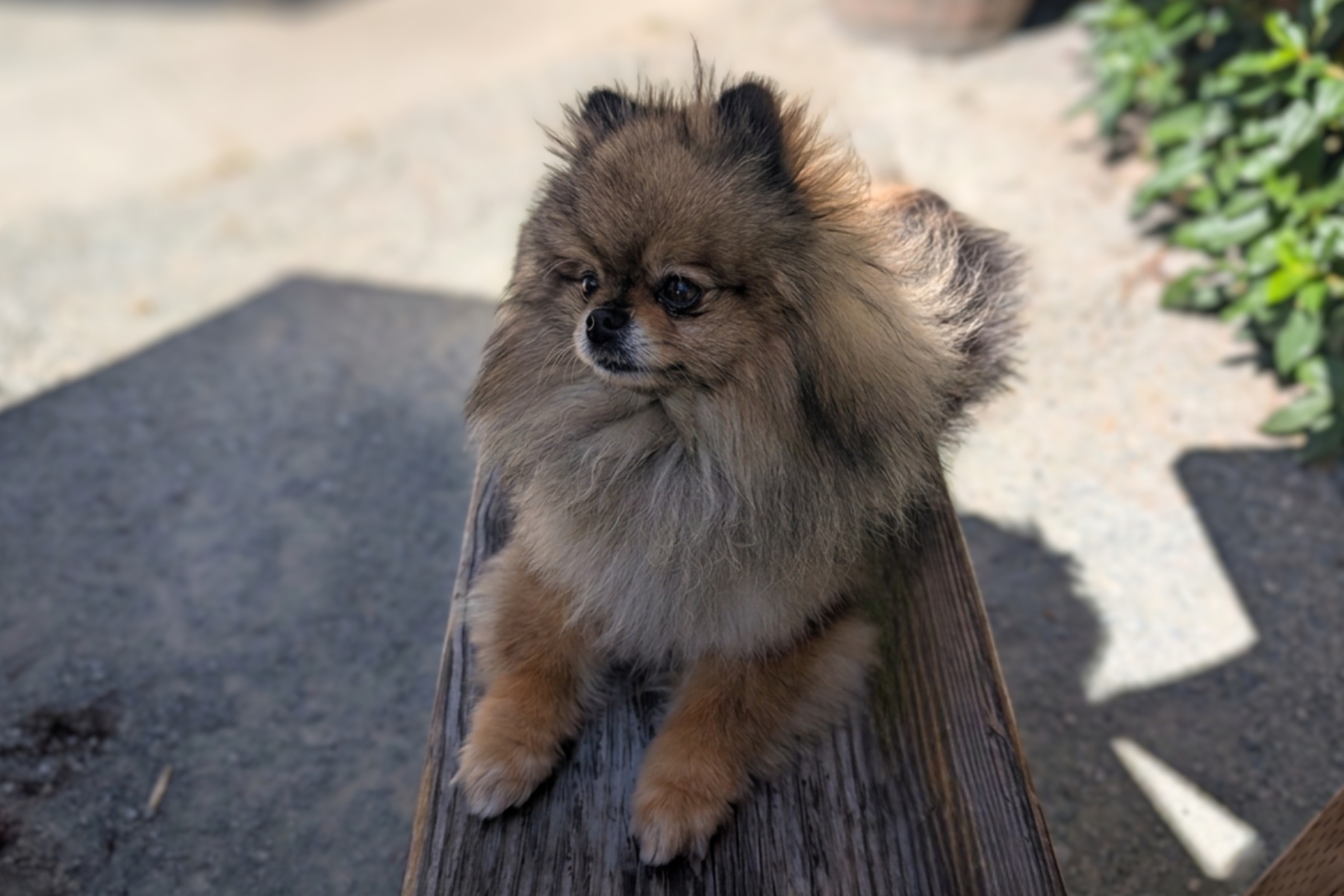
If you bring home exactly one instruction from this article, asking for this cut is it. It’s also what you’re looking at in the photo at the top of this page: that coat gets scissor trimmed on a regular schedule, and clippers have never touched it.
The fox cut
A slightly more sculpted version of the same idea. The body coat is scissored to follow the dog’s natural lines a little more closely, the face is left natural and pointed, and the result reads foxy rather than round. Still scissors, still guard-hair territory, still safe when the groomer keeps length. It suits Poms with the leggier, spitz-forward build.
The teddy bear cut, the longer version
Here’s where the names start lying to you, so this one gets its own section below too. A long teddy bear cut, done with scissors, leaving an inch or more of coat everywhere and just rounding the outline and the face, sits at the safe end. The undercoat is never touched. Plenty of groomers do exactly this and call it a teddy bear cut, and those dogs are fine.
The problem is that the same two words also describe a short all-over clipper cut. Same name, completely different risk. Which brings us to the other list.
The sanitary trim (the most underrated item on this list)
You can ask for this in addition to any of the options above.
Feet trimmed round, hair between the paw pads taken down, sanitary area clipped short. All standard, all safe. The sanitary clip is the one place clippers are routine, and that’s fine: it’s a small area of mostly non-coat hair, not the insulating double coat on the body.
And two specific requests inside the sanitary trim are lifesavers, especially if nobody has told you they’re an option:
- For boys: the belly trim. The hair on a male Pom’s lower belly grows right into the line of fire, and an intact fluffy belly means a dog who pees on his own coat a little bit, every single time. Asking the groomer to take the belly hair shorter fixes it completely, and it’s invisible from above. The dog looks exactly as fluffy as before.
- The pants shaping. A Pomeranian’s pants can be scissored so the hair around the rear is angled away from where poop actually exits. Less hair in the path means far fewer of those late-night discoveries where something got caught on the way out. Same deal: from any normal angle, the dog still has full, dramatic pants.
Both of these keep the Pom silhouette entirely intact. They’re hygiene engineering hidden inside the fluff, and they’re part of what our groomer does for our dogs at every appointment.
The styles that put the coat at risk
The lion cut
The body clipped down short, a mane left on the head and chest, a plume left on the tail. It photographs adorably and the internet loves it. Structurally, it is a shave-down of most of the dog. Everything our shaving article says about post-clipping alopecia applies to the entire clipped area, which is most of the body. The mane doesn’t protect the dog from any of it.
Some lion-cut Poms regrow fine. Some spend a year or more in patchy, uneven regrowth, and some coats never come back. There is no way to know in advance which dog you have, so that’s the risk you take.
The short teddy bear cut (and the “puppy cut”)
The clipper version: coat taken down to an inch or under, all over. This is the most common way Pomeranian coats get ruined, precisely because the name sounds harmless and the result looks so cute on day one. At that length the clippers are cutting through undercoat, and the regrowth risk is the same as any shave. If a groomer quotes you a teddy bear cut, the only question that matters is the one from the top of this article: scissors keeping length, or clippers going short?
The “summer cut”
We commonly read about owners who want to take their Pomeranian’s coat short for the summer.
The “summer cut” is not a good idea for your Pomeranian, and the reasoning surprises most people. The double coat is not a winter parka the dog is stuck wearing in July. It’s a temperature regulation system that works in both directions: the undercoat traps an air buffer that slows heat coming in, and the guard hairs block direct sun on skin that can burn. A clipped Pom in summer is more exposed to heat, not less.
What actually helps a hot Pom is getting the dead undercoat out so air can move through the coat: a bath, a proper blowout, and brushing while the coat is damp. That’s the routine from blowing coat season, which conveniently lands right before the hot months. A blown-out coat in July does more for the dog than a clipped one, and it doesn’t gamble the guard hairs to do it.
If a groomer suggests taking the coat down for the heat, that’s a signal they’re not thinking in double-coat terms, and it’s worth a polite conversation before anyone picks up clippers.
What about Boo? The most famous Pomeranian haircut ever
You can’t write about Pomeranian haircuts without addressing Boo, because half the people asking a groomer for a short teddy bear cut are really asking for Boo, whether they know his name or not. Boo was the adorable and Facebook-famous Pom (2006 to 2019) with the plush, rounded, stuffed-animal clip and sixteen million followers, and that one dog reshaped what the world thinks a Pomeranian looks like.
Here’s the part the viral photos never carried: Boo’s haircut wasn’t a style choice. By his owner’s account, his coat had serious problems and the short cut began as a practical response to them, matting being the widely reported culprit. The most famous Pomeranian look in the world started as a coat-problem haircut that happened to come out adorable on that particular dog.
And that’s exactly why copying it is a gamble. Boo’s coat happening to regrow into that dense, plush teddy texture, clip after clip, was luck of the genetic draw, not the standard outcome. For the average Pom, that same short clip is the risky teddy bear cut from the section above: clippers through the undercoat, months of cottony regrowth, and a real chance the coat never comes back right.
If you love the Boo aesthetic, the longer scissored teddy bear cut gets you a rounded, plush-toy outline while leaving the coat system intact. That’s the version to ask for by description, not by name.
How often should a Pomeranian get a haircut?
Ours go every 6 weeks, for a trim and a sanitary. That cadence sits in the middle of the typical 4-to-8-week range, and it’s held up across both of our full-breed Poms. There’s no biological schedule forcing it, since the coat isn’t getting longer. The trim cadence is really a hygiene-and-tidiness cadence, and it can stretch further if you’re handling baths at home.
What matters more than frequency is what happens between appointments. A coat that gets brushed down to the skin a few times a week arrives at the groomer mat-free, and a mat-free coat never generates the “we had to shave it” phone call. The daily-maintenance side lives in our brush guide; the Chris Christensen Big G is the tool doing that job in our house. Real appointment prices, including what trims cost versus full grooms, are in the grooming cost breakdown.
What to say to the groomer (the exact words)
Style names are ambiguous, so don’t rely on them. Describe the outcome instead:
- "Scissor trim only, no clippers on the body." This single sentence eliminates every risky outcome on the list above. Clippers for sanitary and paw pads are fine, say so.
- "Leave the guard hairs long, just tidy the outline." Now the groomer knows you know what guard hairs are, which quietly changes the conversation.
- "This breed is high-risk for post-clipping alopecia, so nothing short." A groomer who works with double coats will finish the sentence for you. A groomer who looks blank just told you something important.
If your dog’s coat is prone to matting, try to tackle it before the groomer. Mats caught early are workable: our detangling guide covers what’s realistic at home.
What we do with our three Poms
Nothing on this page is theoretical for us. Three Poms, three completely different coats: Beignet’s dense wolf sable, Bella’s senior coat, and Boqui still growing into his adult coat (the awkward in-between stage is the puppy uglies, and it’s normal, not a reason to cut anything).
None of them has ever had a clipper cut, and the plan is to keep it that way. The routine is unglamorous: every 6 weeks they go in for a trim and a sanitary. The trim is scissor work, outline and paws. The sanitary covers the parts that make life with three dogs livable, including the belly trim for the boys and the pants shaping from earlier in this article. They look “tidier,” not drastically different.
And once you have a coat maintenance routine, the haircut question mostly dissolves. Coat brushed through regularly, bathed and blown out on schedule, and your Pom’s coat will generally look and feel good. The whole system is in the grooming routine hub if you want it end to end.